AI-Augmented Solution Architecture (ASA+)
Overview
ASA+ (AI-Augmented Solution Architecture) adopts a more augmented, integrative, absorptive, evolutionary, hybrid, or fused approach to AI enterprise solutions, compared with the AI-first orientation of ASA approach (AI-Native Solution Architecture, see this link). It is positioned as an enterprise AI absorption and coexistence architecture, aiming to maintain architectural continuity while enabling AI augmentation.
ASA+ Architectural Approach
ASA+’s architectural approaches include:
-
AI absorption approach (beyond AI adoption): progressing from adopted intelligence toward owned intelligence
-
Coexistence of operational modes: supporting autonomy, semi-autonomy, automation, and semi-automation to enable gradual augmentation
-
Governance-heavy control: emphasizing stronger governance mechanisms beyond the validation and adaptation focus of AI-native solution architecture
-
System integration focus: addressing integration challenges in heterogeneous enterprise environments
-
Enterprise alignment: stronger alignment with business requirements, data strategies, and organizational assurance objectives
ASA+ Modeling Elements
As an AI-augmented architectural approach, ASA+ incorporates both non-AI elements and AI-specific elements (which are heavily emphasized in AI-native architecture). As a result, ASA+ operates on a mixed set of AI and non-AI elements, including a shared subset with the base ASA approach. Table 1 presents the primary AI and non-AI elements of ASA+.
| Element Name | AI-Specific | Definition |
|---|---|---|
| Access Interface | Represents the interaction channels, UI/UX surfaces, and entry points through which humans engage with the solution. | |
| Application | Represents a bounded software system, enterprise application, or business component that integrates with or consumes AI capabilities. | |
| App Logic | Represents explicitly defined non-GUI logic, control flow, or compositional behavior of an application. | |
| Data Service | Represents services responsible for data access, integration, transformation, federation, and transactional integrity. | |
| Technical Component | Represents reusable technical capabilities, utility services, and cross-cutting infrastructure functions available across the solution. | |
| AI Agent | Yes | Represents an autonomous AI entity capable of goal-directed reasoning, planning, and action. |
| AI Coordinator | Yes | Represents the coordination logic, workflow control, and multi-agent management that sequences and routes AI operations. |
| Context State | Yes | Represents the mechanisms for managing conversational state, memory, prompt engineering, and interaction coherence. |
| AI Model | Yes | Represents the models, inference engines, and reasoning frameworks that generate predictions, decisions, or outputs. |
| Knowledge Service | Yes | Represents the semantic retrieval, RAG, embedding, and knowledge management capabilities that ground AI responses in relevant information. |
| AI/ML Lifecycle | Yes | Represents the lifecycle management processes for model training, experimentation, versioning, and deployment. |
| Autonomous Tool | Yes | Represents external functions, plugins, and third-party services that extend AI capabilities through invocation. |
Table 1: Primary ASA+ Elements
For the full list of ASA+ modeling elements and its foundational specification, refer to this link.
ASA+ architectural services can be categorized into three types: fully autonomous applications, agentic applications with varying degrees of autonomy, and deterministic automation applications.
ASA+ Example
Here are examples of ASA+ modeling cases.
Canonical Case Example
Figure 1 illustrates an ASA+ for an AI-Augmented Enterprise Operations Platform. This example demonstrates:
-
AI augmentation instead of replacement,
-
coexistence with enterprise systems,
-
governance-heavy architecture,
-
hybrid operational control,
-
human approval boundaries,
-
enterprise integration continuity.
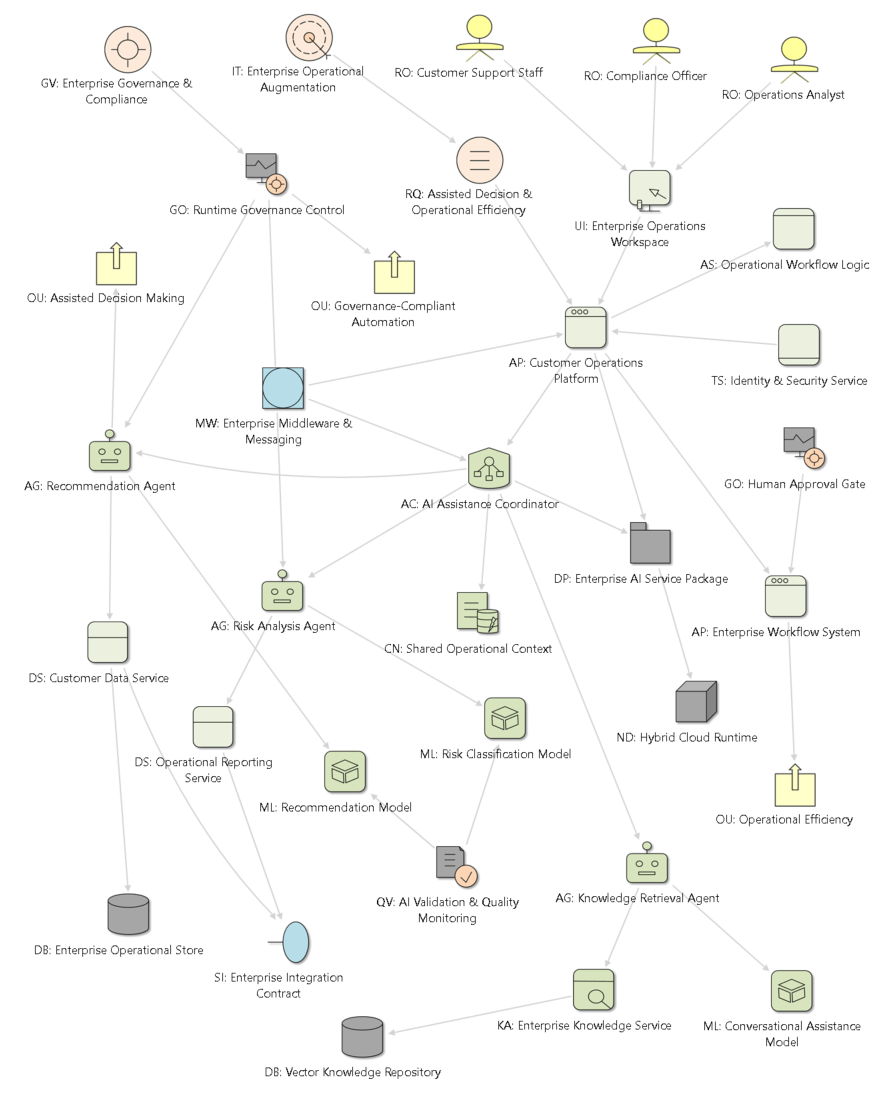
Figure 1: ASA+ for an AI-Augmented Enterprise Operations Platform
Edge Case Example
Figure 2 shows ASA+ edge case for a High-Risk Human-Governed AI Decision Environment. This edge case demonstrates:
-
constrained autonomy,
-
governance escalation,
-
partial AI delegation,
-
operational safeguards.
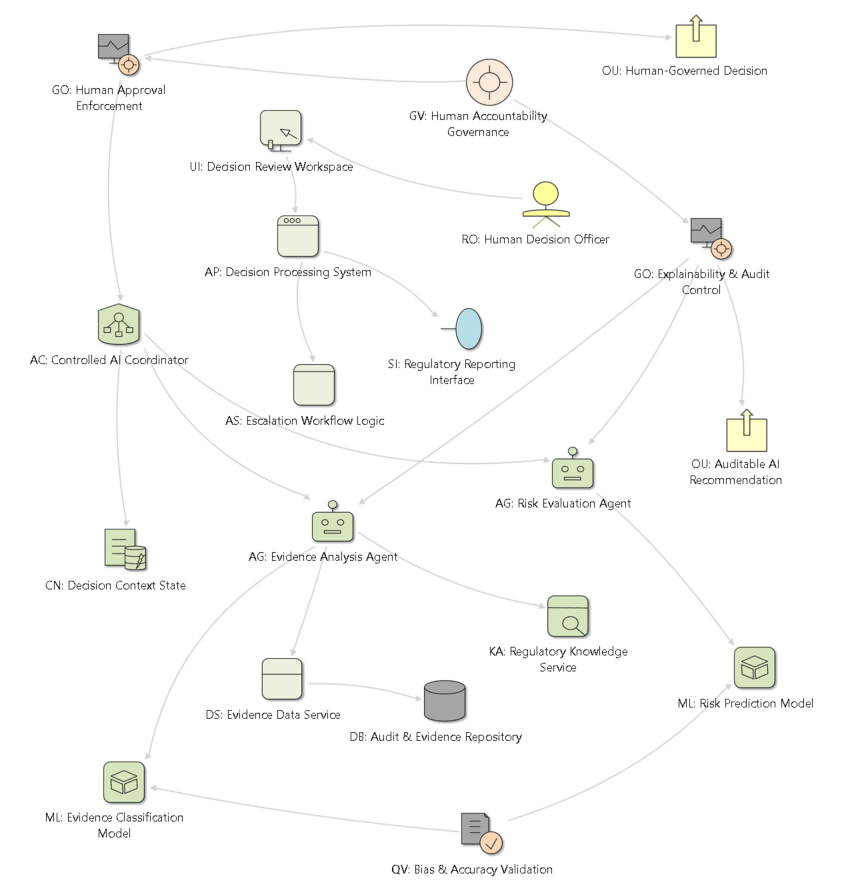
Figure 2: ASA+ Edge Case Example
Related Model Specification and Architecture
ASA+ uses its model specification and maintains a close relationship with AI-native solution architecture.
For the relationship and relevance among ASA model and approach, and ASA+ approach, see this link.