AI Solution Architecture (ASA) Model Specification
Introduction
Issue Statement
Many organizations are now using AI agents. The challenge is no longer just how to apply AI tools or validate AI testing scenarios. AI solutions have moved beyond simple querying and exploration. The real issue is enterprise-wide adoption and absorption of AI. As AI solutions scale across the enterprise, they require a clear architectural model to guide direction, redesign, and long-term sustainability.
Enterprise architecture (EA) is increasingly becoming a context curator, heavily assisted by AI, while solution design (SD), with its more confined scope, is largely being automated by AI. However, enterprise solution architecture (ESA) or large-scale solution architecture (SA), which bridges EA and SD, operates within unique environmental and organizational constraints that still require significant human involvement, whether through human-centric oversight, delegation, or collaboration. Without this level of architectural guidance and assurance, AI may operate in ways that fail to align with business intent or produce systems that become uncertain or overly complex, difficult to adapt, and hard to maintain.
Objective
ASA (also referred to as AI-ESA) is based on the enterprise solution architecture (ESA) modeling approach (also referred to as Agile ESA, abbreviated as AESA or A-ESA) to support enterprise-grade AI solution architecture. It has the following objectives:
-
Holistic view: The ASA adopts a holistic architectural approach to identify, validate, and govern implicit requirements and non-trivial concerns that are not easily measurable. It aims to achieve architectural sustainability through a simple yet effective set of elements that support intuitive consideration of architectural characteristics such as granularity, layering, and coupling at the solution architecture level.
-
AI-human collaborative modeling: The ASA model facilitates architectural thinking and enables more effective collaboration between humans and AI at the appropriate level of architectural abstraction, allowing both to operate through a common language that captures key solution architecture concerns. Importantly, the model is intended primarily to support human understanding and decision-making. For smaller or easily understandable solutions, ASA may not be necessary.
-
Architectural validation and conformance:
-
Architectural intent continuity through intent and metric elements
-
Operational scalability through service-based and integration elements
-
AI-human governance through both AI and non-AI elements, including governance-related elements
-
Modeling Approach
ASA follows its foundational ESA modeling approach, which consists of six constituents: thinking framework, method specification (foundation specification), architectural styles, measurement criteria, governance techniques, and tool support derived from practical enterprise solution projects (see References). This document focuses only on the ASA element specification, which is a subset of the broader ESA modeling approach.
Principle
ASA advocates the S3 principle: Systematics rooted in Simplicity and Significance.
-
Systematic: correlation and coherence across all primitive elements
-
Simple: simple yet clear, agile, and flexible
-
Significant: focused on significant architectural concerns rather than detailed solution views
The S3 principle serves as the governing philosophy of the ASA specification. It also provides the evaluation criteria for solution architecture and the heuristics for architectural modeling.
Modeling Rule
-
Element-first approach: The model uses simple yet panoramic elements to convey holistic architectural thinking, or a selected set of elements for significant scenarios, rather than being constrained to specific diagram views.
-
Node-style iconic notation: The model emphasizes key architectural element types, represented iconically along with their relationships, using clear prefixes and/or instance mapping to express architectural thinking instead of relying on verbose descriptions.
-
Intersectional mapping: The model highlights overlapping concerns across architecture and service layers.
-
Architectural measurement: The model incorporates key architectural choice element together with governance control elements.
Element Specification
As part of the ESA specification, ASA inherits many core ESA elements while introducing AI-specific elements. To maintain simplicity, the total number of elements is intentionally kept minimal while still addressing both primitive constructs and higher levels of architectural abstraction. At the same time, ASA is designed to function as a stand-alone specification, sufficient for general enterprise AI solution architecture purposes.
Element Definition
Table 1 provides a brief definition of 30 ASA elements, usage examples or instance-level representations.
| Element Name | Definition | Instance / Usage Example |
|---|---|---|
| Intent | Represents the strategic intent, value drivers, and guiding principles that justify and direct the solution. | Strategic goals, desired business outcomes, measurable impact, expected ROI, cost/value, core value propositions, and guiding architectural principles that drive solutions. |
| Capability | Represents the business, technical and AI abilities the solution enables or delivers. | Business and technical capabilities that the solution enables or delivers, encompassing both enterprise-level functional capabilities and specific AI capabilities such as prediction, classification, generation, or natural language understanding. |
| Requirement | Represents the functional and non-functional needs, scenarios, quality expectations, and acceptance criteria the solution must satisfy. | Use case scenarios, user stories, business process flows, functional and non-functional requirements, quality metrics, implicit requirements, acceptance criteria, and context-specific solution needs. |
| Governance | Represents the policies, compliance obligations, ethical controls, and accountability structures that guide responsible solution behavior. | Governance guided by principles, policies, regulatory compliance requirements, guardrails, ethical guidelines, bias detection and mitigation controls, responsible AI frameworks, and accountability mechanisms. |
| Decision | Represents the key architectural choices, evaluated trade-offs, and rationale that shape the solution design. | Critical decision points, architectural trade-offs, design alternatives evaluated, rationale for selected approaches, and strategic technology choices that shape the solution. |
| Access Interface | Represents the interaction channels, UI/UX surfaces, and entry points through which humans engage with the solution. | User experience or interaction channels, UI/UX components, conversational interfaces (GUI, CLI, voice, media), call access, app triggers, and entry points for human-AI interaction. |
| Application | Represents a bounded software system, enterprise application, or business component that integrates with or consumes service capabilities. | Bounded software unit, enterprise applications, legacy systems, AI-native applications, microservices, and business components that integrate with. |
| App Logic | Represents explicitly defined non-GUI logic, control flow, or compositional behavior of an application. | Explicitly defined non-GUI application behavior and control logic, business rules engines, conditional branching logic, and application composition. |
| Data Service | Represents services responsible for data access, integration, transformation, federation, and transactional integrity. | Data access layers, streaming services, data transformation pipelines, and services that provide or prepare data for integration, federation, transactional access, and data quality assurance. |
| Technical Component | Represents reusable technical capabilities, utility services, and cross-cutting infrastructure functions available across the solution. | Reusable technical utilities, infrastructure services, cross-cutting capabilities such as authentication services, logging frameworks, and notification services shared across the solution. |
| Interface Contract | Represents the defined interface, contract, API, or protocol through which components expose and consume capabilities. | Service interface, RESTful APIs, GraphQL interfaces, gRPC service contracts, Model Context Protocol (MCP) endpoints, webhooks, and interface specifications that define synchronous service interaction boundaries. Note: When the Message & Event element is not used, it’s also used to indicate asynchronous message contracts, domain events, integration event schemas, event-driven notification payloads, and information contracts governing data exchanged through messaging and event streaming channels. |
| AI Agent | Represents an autonomous AI entity capable of goal-directed reasoning, planning, and action. | Autonomous AI entities (e.g., LLM-based, goal-oriented agents), ReAct and plan-execute agents, specialized AI assistants, and conversational bots operating with decision-making autonomy. |
| AI Orchestrator | Represents the coordination logic, workflow control, and multi-agent management that sequences and routes AI operations. | Agent orchestration engines, multi-agent coordination frameworks, task routers, workflow controllers, and application logic that sequences and manages AI model invocations and agent interactions. |
| Context State | Represents the mechanisms for managing conversational state, memory, prompt engineering, and interaction coherence. | Context window management, conversation state tracking, session memory stores, prompt engineering templates, context caching mechanisms, and strategies for maintaining interaction coherence across multi-turn dialogues. |
| AI Model | Represents the models, inference engines, and reasoning frameworks that generate predictions, decisions, or outputs. | LLMs, foundation models, fine-tuned domain models, ensemble methods, reasoning and inference engines, decision logic frameworks, and AI/ML models that produce predictions, classifications, or generated outputs. |
| Knowledge Service | Represents the semantic retrieval, RAG, embedding, and knowledge management capabilities that ground AI responses in relevant information. | RAG services, vector databases and embedding services, semantic retrieval pipelines, knowledge index management, knowledge freshness monitoring, data sources, and configuration services that govern AI knowledge access quality and relevance. |
| AI/ML Lifecycle | Represents the lifecycle management processes for model training, experimentation, versioning, and deployment. | MLOps and AIOps pipelines, model training and fine-tuning workflows, experiment tracking platforms, model registries, versioning systems, and CI/CD pipelines for automated AI model deployment and lifecycle management. |
| Tool | Represents external functions, plugins, and third-party services that extend AI capabilities through invocation. | External function-calling capabilities, third-party API integrations, plugins, code execution environments, web search tools, and actions invoked autonomously by AI agents to fulfill task requirements. |
| Data Store | Represents the repositories where structured, unstructured, or semi-structured data is persisted and managed. | Databases, data warehouses, data lakes, vector databases for embedding storage, object storage systems, file repositories, and knowledge bases that persist solution data assets. |
| Deployment Package | Represents a discrete, deployable and scalable package of software or functionality. | Deployment packages that define the deployable and independently scalable units of the solution. Containerized microservices, serverless functions, Kubernetes pods, and virtual machine images. |
| Node | Represents the physical and virtual compute resources that host and execute the solution. | Physical and virtual compute resources, GPUs, TPUs, CPUs, edge devices, cloud compute instances, clusters, and infrastructure. |
| Quality & Adaptation | Represents the testing, validation, and continuous improvement mechanisms that assess solution quality and performance. | Model evaluation (evals) and tracing, performance metrics dashboards, safety and bias evaluation frameworks, A/B testing pipelines, feedback loop mechanisms, continuous monitoring, and model quality improvement workflows. |
| Governance Control | Represents the operational controls, policy enforcement, observability, security monitoring, and human oversight mechanisms active during execution. | Runtime governance operations, policy enforcement mechanisms, access controls, audit trails, and operational risk management, security monitoring, observability dashboards, and human-in-the-loop (HITL) oversight. |
| Middleware | Represents the system and platform software, middleware, and services that underpin application execution and integration. | System software, platform software and services such as PaaS (Platform as a Service) and iPaaS (infrastructure PaaS) that underpin cross-component communication and operational management, service meshes, application servers, message brokers, cost control services. Note: Common subtypes include integration and messaging (MW-ESB), security (MW-SEC), API gateway (MW-GW), and analytics (MW-DA). |
| Group | Represents a logical or functional organizational structure used to partition, layer, or modularize the architecture. | Architectural layer groupings (e.g., AI layer, data layer), domain-driven bounded contexts, functional subsystem boundaries, location boundaries, and service decompositions that organize solution elements into coherent structural units. |
| Role | Represents the individuals, roles, personas, or entities that interact with or have a stake in the solution. | User roles, system roles, stakeholders, actors, system actors, personas, oversight authorities, and individuals or entities with specific needs, responsibilities with the solution. |
| Task | Represents discrete activities, process steps, decisions, and work units performed by humans or automated systems within the solution. | Discrete activities, planning tasks, work units, decisions supported by AI, business processes, process steps, automated tasks, and human tasks within the solution workflow. |
| Input | Represents the data, signals, queries, and information consumed by the solution. | User inputs (prompt and query or prompt package), data sources, signals, inference data, external feeds, batch data, streaming data, and any information consumed by the solution. |
| Output | Represents the results, recommendations, and responses produced by the solution. | Generated artifacts, predictions, recommendations, confirmations, decisions, reports, notifications, feedback to users, and results produced by the solution. |
| Note | Represents commentary, annotation, or interpretive explanation of the architecture. | Clarifying comments on complex interactions, interpretive notes, and contextual explanations added to views for enhanced communication. |
Table 1: ASA Element Definition
Element Representative Notation
Table 2 presents the recommended prefixes and iconic notations used in the ASA specification.
| Name | Prefix | Iconic Representation |
|---|---|---|
| Intent | IT |  |
| Capability | CP |  |
| Requirement | RQ |  |
| Governance | GV |  |
| Decision | KC |  |
| Access Interface | UI |  |
| Application | AP |  |
| App Logic | AS |  |
| Data Service | DS |  |
| Technical Component | TS |  |
| Interface Contract | SI |  |
| AI Agent | AG |  |
| AI Orchestrator | AC |  |
| Context State | CN |  |
| AI Model | ML |  |
| Knowledge Service | KA |  |
| AI/ML Lifecycle | AL |  |
| Tool | TL |  |
| Data Store | DB |  |
| Deployment Package | DP |  |
| Node | ND |  |
| Quality & Adaptation | QV |  |
| Governance Control | GO |  |
| Middleware | MW |  |
| Grouping | GP |  |
| Role | RO |  |
| Task | TK |  |
| Input | IN |  |
| Output | OU |  |
| Note | NT |  |
Table 2: ASA Element Representative Notation
Element Category & Naming
ASA element layering and categorization follow an agile approach to support simple and adaptable modeling adoption. Elements can be grouped according to practical or organizational needs. Common categories include three typical element levels:
-
Intent & Metrics Elements
-
Functional Elements
-
Operational Elements
For AI enterprise solutions, integration elements (such as Middleware, Interfact Contract, and Message event) are often categorized independently. They represent a cross-cutting set of elements spanning both functional and operational categories.
For general AI solution architecture, the AI-specified element names and prefixes are recommended. However, ASA naming remains flexible, and alternative names or prefixes may be used to better align with organizational conventions or habitual understanding.
Table 3 shows the commonly-used ASA categories and naming.
| Category | Name | Other Names |
|---|---|---|
| Intent & Metrics | Intent | Objective & Value |
| Capability | Service Capability | |
| Requirement | Case & Requirement | |
| Governance | Policy & Governance | |
| Decision | Key Consideration & Decision | |
| Functional | Access Interface | Interaction Interface |
| Application | Application | |
| App Logic | App Logic Service | |
| Data Service | Data Service | |
| Technical Component | Technical Service | |
| Interface Contract | API Interface & Contract | |
| Functional-AI Specific | AI Agent | AI Agent |
| AI Orchestrator | AI Coordinator | |
| Context State | Context & Memory | |
| AI Model | Reasoning Model | |
| Knowledge Service | Knowledge Access & Config | |
| AI/ML Lifecycle | AI/ML Pipeline | |
| Tool | Autonomous Tool & Extension | |
| Operational | Data Store | Database |
| Deployment Package | Deployment Unit | |
| Node | Computing Node | |
| Quality & Adaptation | Quality Validation & Feedback | |
| Governance Control | Governance Operations | |
| Middleware | Middleware & Platform Software | |
| General | Group | Domain & Boundary |
| Role | Role & Actor | |
| Task | Task & Step | |
| Input | Input | |
| Output | Output | |
| Note | Note |
Table 3: ASA Element Categories and Alternative Names
Element Customization
On top of the base (foundational) elements, ASA allows the use of customized element notations (the assistive element category in the specification) to map foundational elements in an agile manner, enabling semantic normalization and canonical abstraction mapping for architectural interoperability. This approach supports easier adoption by allowing organizations to use familiar terminology while still conforming to the underlying ESA architectural abstractions, since most commonly used modeling elements can be mapped at the solution architecture level. For example, the assistive element Cloud can be mapped to Node or Domain, while Microservice can be mapped to Application or Deployment Package, depending on the architectural context.
In other words, organizations can preserve local terminology while aligning to the same architectural abstraction model.
Metamodel (Element Relationship) Specification
The element metadata model is primarily shaped by considerations such as rigor, reproducibility, tooling support, machine readability, and AI interpretability. This section introduces three ASA metamodels: the conceptual metamodel, the logical metamodel, and the schema model.
Note that for focused ASA modeling, certain elements are excluded in the above element list, such as Constraint, System, Message & Event, and Deliverable. Some general-purpose elements are also intentionally omitted from the metamodel.
Conceptual Metamodel
The ASA conceptual metamodel (Figure 1) defines architectural meaning and abstraction relationships.
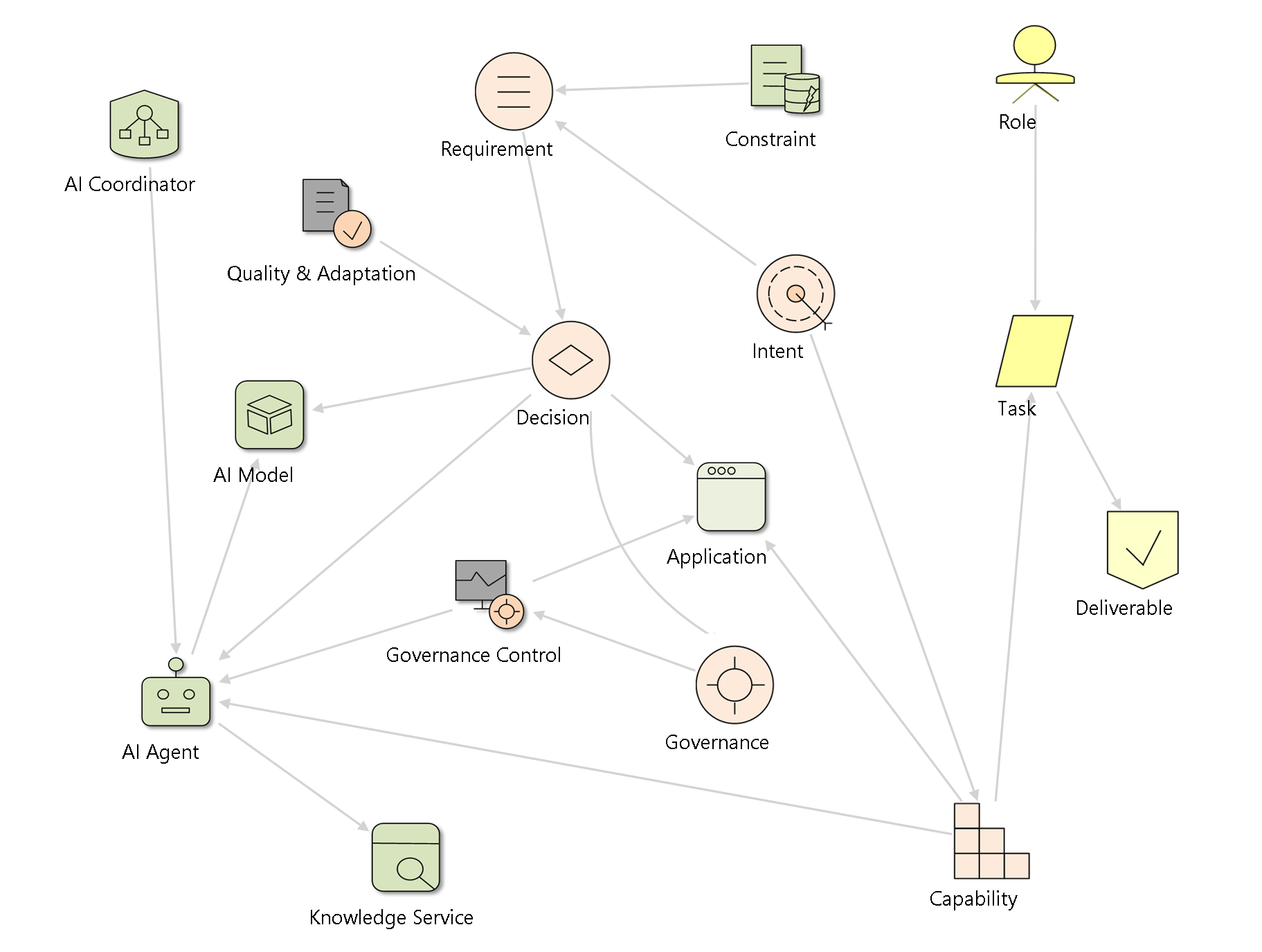
Figure 1: ASA Conceptual Metamodel
Logical Metamodel
The ASA logical metamodel (Figure 2) defines operational interaction and runtime collaboration.
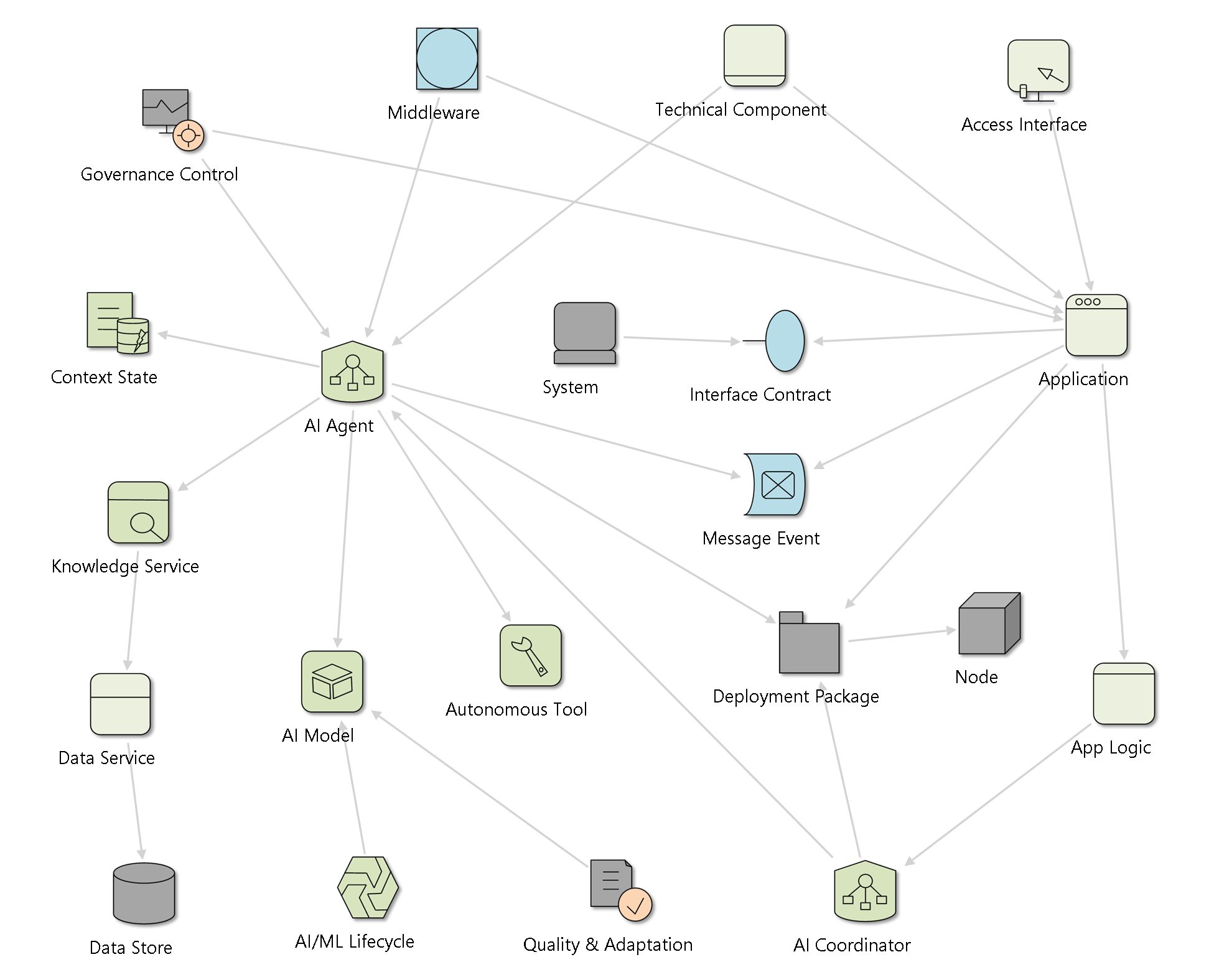
Figure 2: ASA Logical Metamodel
Schema Model
The ASA schema model (Figure 3) defines implementable structural metadata and tool interoperability.
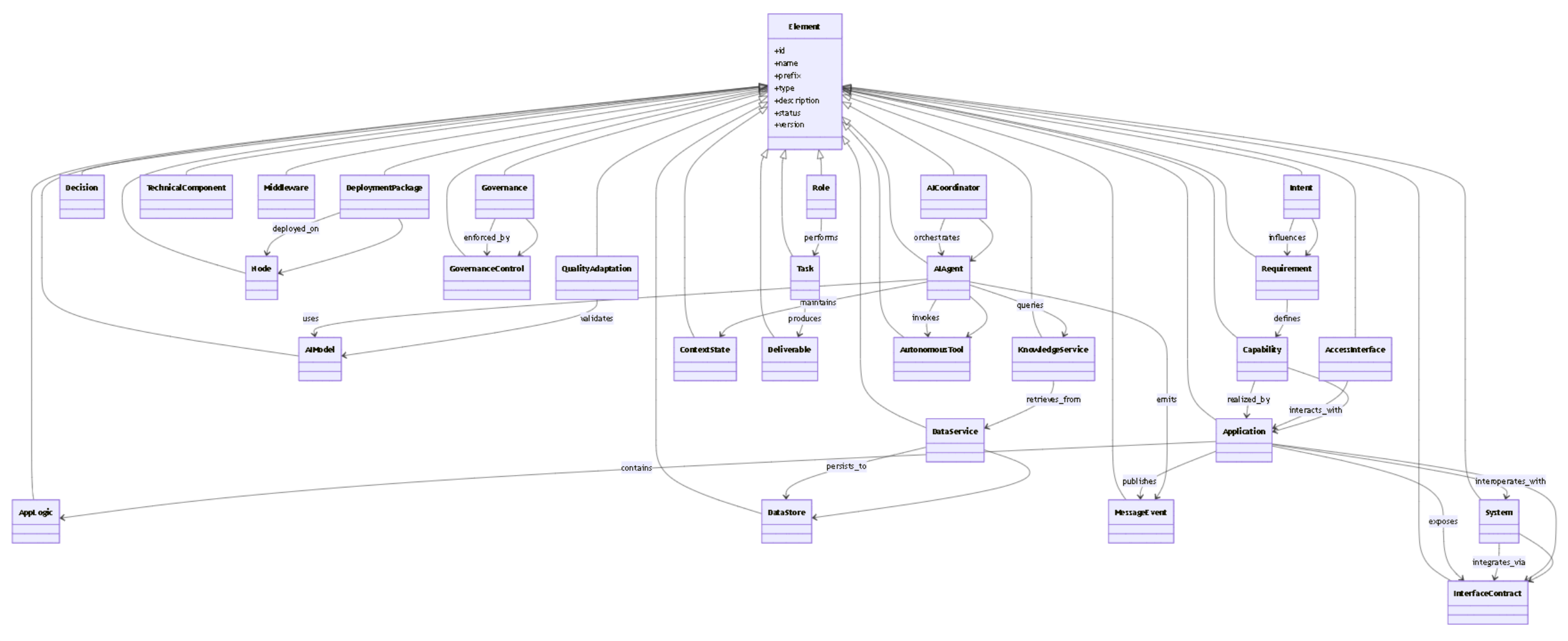
Figure 3: ASA Schema Model
The following presents the Mermaid code for the schema model.
%% mermaid diagram
classDiagram

class Element {
  +id
  +name
  +prefix
  +type
  +description
  +status
  +version
}

class Intent
class Requirement
class Capability
class Governance
class Decision

class Application
class AppLogic
class AIAgent
class AICoordinator
class AIModel
class KnowledgeService
class ContextState

class DataService
class DataStore
class TechnicalComponent
class Middleware

class InterfaceContract
class MessageEvent

class DeploymentPackage
class Node

class GovernanceControl
class QualityAdaptation

class Role
class Task
class Deliverable

class AccessInterface
class AutonomousTool
class System

Element <|-- Intent
Element <|-- Requirement
Element <|-- Capability
Element <|-- Governance
Element <|-- Decision

Element <|-- Application
Element <|-- AppLogic
Element <|-- AIAgent
Element <|-- AICoordinator
Element <|-- AIModel
Element <|-- KnowledgeService
Element <|-- ContextState

Element <|-- DataService
Element <|-- DataStore
Element <|-- TechnicalComponent
Element <|-- Middleware

Element <|-- InterfaceContract
Element <|-- MessageEvent

Element <|-- DeploymentPackage
Element <|-- Node

Element <|-- GovernanceControl
Element <|-- QualityAdaptation

Element <|-- Role
Element <|-- Task
Element <|-- Deliverable

Element <|-- AccessInterface
Element <|-- AutonomousTool
Element <|-- System

Intent --> Requirement : influences
Requirement --> Capability : defines
Capability --> Application : realized_by

Application --> AppLogic : contains
Application --> InterfaceContract : exposes

AICoordinator --> AIAgent : orchestrates
AIAgent --> AIModel : uses
AIAgent --> KnowledgeService : queries
AIAgent --> ContextState : maintains

KnowledgeService --> DataService : retrieves_from
DataService --> DataStore : persists_to

Application --> MessageEvent : publishes
AIAgent --> MessageEvent : emits

DeploymentPackage --> Node : deployed_on

Governance --> GovernanceControl : enforced_by
QualityAdaptation --> AIModel : validates

Role --> Task : performs
Task --> Deliverable : produces


AccessInterface --> Application : interacts_with

AIAgent --> AutonomousTool : invokes

System --> InterfaceContract : integrates_via

Application --> System : interoperates_with

Intent --> Requirement
Governance --> GovernanceControl
Capability --> Application
AICoordinator --> AIAgent
AIAgent --> AutonomousTool
DataService --> DataStore
DeploymentPackage --> Node
Application --> InterfaceContract
System --> InterfaceContract
View Specification
As an element-first modeling approach, ASA does not enforce a strict view specification. The core views typically include the functional view, deployment mapping view, and intent & metrics view (optional if the key elements are already represented in other views).
For a more comprehensive model, the recommended views may also include: capability mapping view, case scenario view, solution overview view (e.g., solution context, DevOps environment), integration view, information flow view, validation view, and operational view.
Related ASA Architectural Approaches
ASA is primarily designed for modeling ASA approach and pattern and ASA+ approach.
For descriptions and examples of ASA and ASA+, refer to their respective repositories: the ASA repository (see this link) and the ASA+ repository (see this link).
For the relationship and relevance among ASA model spec, ASA, and ASA+, see this link.
Relationships to Prevailing Models
The following provides a brief comparison between Enterprise Solution Architecture (ESA) modeling (on which ASA is based) and several related specifications and modeling approaches:
-
UML – Primarily a software engineering approach originating from object-oriented design and later extended to component-based design. It is largely implementation-centric.
-
ArchiMate – Focused on enterprise architecture, with a different conceptual perspective and modeling mindset from solution architecture.
-
C4 – Primarily aimed at software architectural and component-based design. While effective for software structure visualization, it is not sufficient to address the full scope of enterprise solution architecture.
It should also be noted that ASA is not intended to be:
-
a business capability model, an enterprise architecture (EA) replacement, or similar framework
-
a BPM methodology, cloud reference architecture, or equivalent approach
-
a software development lifecycle methodology, implementation or design framework, UML replacement, or similar specification
-
a project management methodology, or related discipline
Further Enhancement
This initial version is intended to support further academic research and continued refinement toward broader adoption or integration with existing solution architecture models. See CONTRIBUTING.md for involvement.
References
-
Gu, Sean. Agile Enterprise Solution Architecture - An IT Service-Based Modeling Approach. Vernal Press, 2021.
-
Gu, Sean. Mastering Enterprise Solution Modeling. APRESS, 2024
-
Choudhury, Abhik, et al. Modern Data Architecture in AI. BPB, 2025.
-
Kesby, Matt. Untangling AI. Wiley, 2026.
-
Whittle, Jon. AI for Business: A Guide to AI Adoption. CSIRO, 2026.
-
Google Cloud Well-Architected Framework - AI/ML Perspective.