AI Solution Architecture (ASA) Approach and Application Pattern
Overview
Many organizations are adopting AI without a clear understanding of how to integrate and absorb it into their broader ecosystem. The AI Solution Architecture (ASA) Approach provides blueprint-level architectural maps that can be implemented in AI solutions serving business objectives. The approach is governed by the ASA model specification to ensure shared understanding among key stakeholders and to enable consensus through a common architectural language.
ASA Approach
ASA is an architectural operationalization approach for AI-native enterprise solutions governed by ASA model abstractions. In simple terms, ASA architecture represents an AI-native architectural orientation for adaptive solutions that goes beyond prompts, agents, AI tooling, and isolated AI implementations.
It emphasizes:
-
AI-first architectural adoption: autonomous orientation and execution within defined architectural constraints
-
Governance abstraction: focusing on validation and adaptation, including feedback loops, continuous learning, semantic alignment, AI/ML lifecycle considerations as part of solution management, and architectural guardrails
-
Architectural coordination: agentic orchestration and sustainability under large-scale AI system complexity
-
Data-centric architecture: centering on AI and data architecture, including data input and sources, transformation, storage, and management. It also considers key data services such as data orchestration, model reasoning capabilities, knowledge access, context management, data APIs, intent awareness, and data validation loops to better serve enterprise business needs
ASA Modeling Elements
As an AI-native architectural approach, ASA focuses on AI-specific elements, as shown in the following list (Figure 1) briefly defined in Table 1.
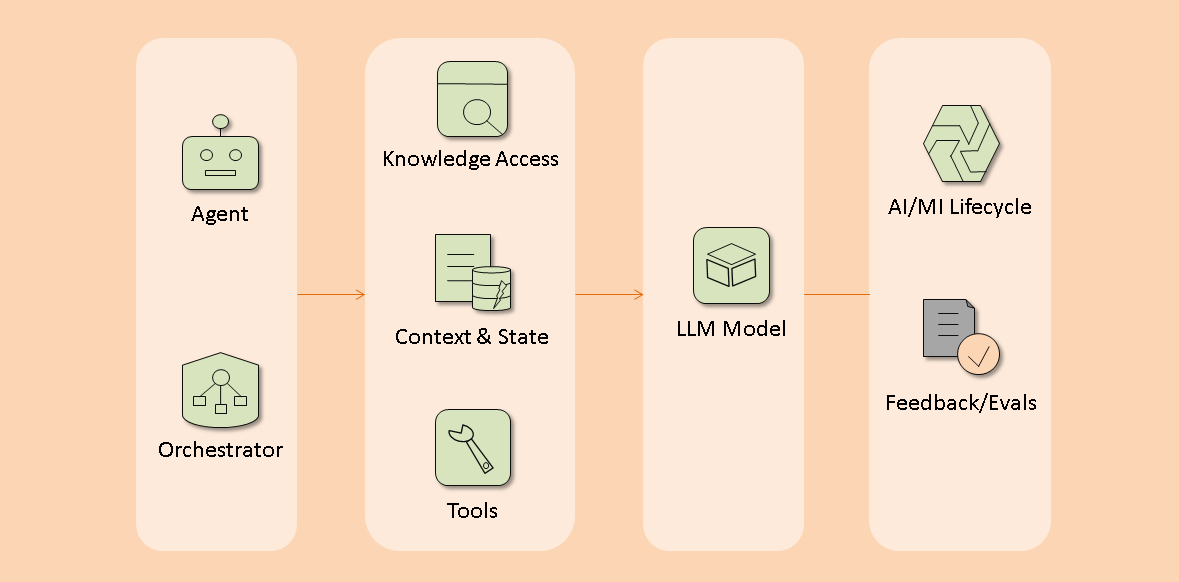
Figure 1: AI Modeling Elements
| Element | Prefix | Brief Definition |
|---|---|---|
| AI Agent | AG | Represents an autonomous AI entity capable of goal-directed reasoning, planning, and action. |
| AI Orchestrator (Coordinator) | AC | Represents the coordination logic, workflow control, and multi-agent management that sequences and routes AI operations. |
| Context Management (Memory State) | CN | Represents the mechanisms for managing conversational state, memory, prompt engineering, and interaction coherence. |
| AI Model (Reasoning) | ML | Represents the models, inference engines, and reasoning frameworks that generate predictions, decisions, or outputs. |
| Knowledge Service (Access and Config) | KA | Represents the semantic retrieval, RAG, embedding, and knowledge management capabilities that ground AI responses in relevant information. |
| Tools | TL | Represents external functions, plugins, and third-party services that extend AI capabilities through invocation. |
Table 1: Key AI-Specific Elements
The six key AI architecture elements have a matching acronym “TOCKAM” (first letter of each element in Table 1) pronounced as “token.” The TOCKAM is mnemonic.
For most AI solutions, closely related elements - such as input, output, and governance control - as well as non-AI elements (not shown in Figure 1) are also used as supplementary elements. For the complete set of ASA modeling elements, refer to the ASA model specification (see this link), on which ASA appraoch is based.
If the solution is AI-augmented in nature, the ASA+ (AI-Augmented Solution Architecture) approach (see this link) can be applied.
In simple terms, both ASA and ASA+ approaches use ASA model elements for enterprise AI solution modeling, but they differ in focus and application scope. For their relevance and relationship, see the following “Related Model Spec and Architecture” section.
ASA Pattern & Example
ASA patterns mean more architectural usage pattern, orchestration pattern, operational topology, governance and architectural mapping patterns, rather than software design patterns or normative architectural style patterns.
An ASA Pattern Example
Note from the Figure 2 pattern example, AI-native still requires app logic, data services, and technical services. but they are NOT the architectural center of gravity.
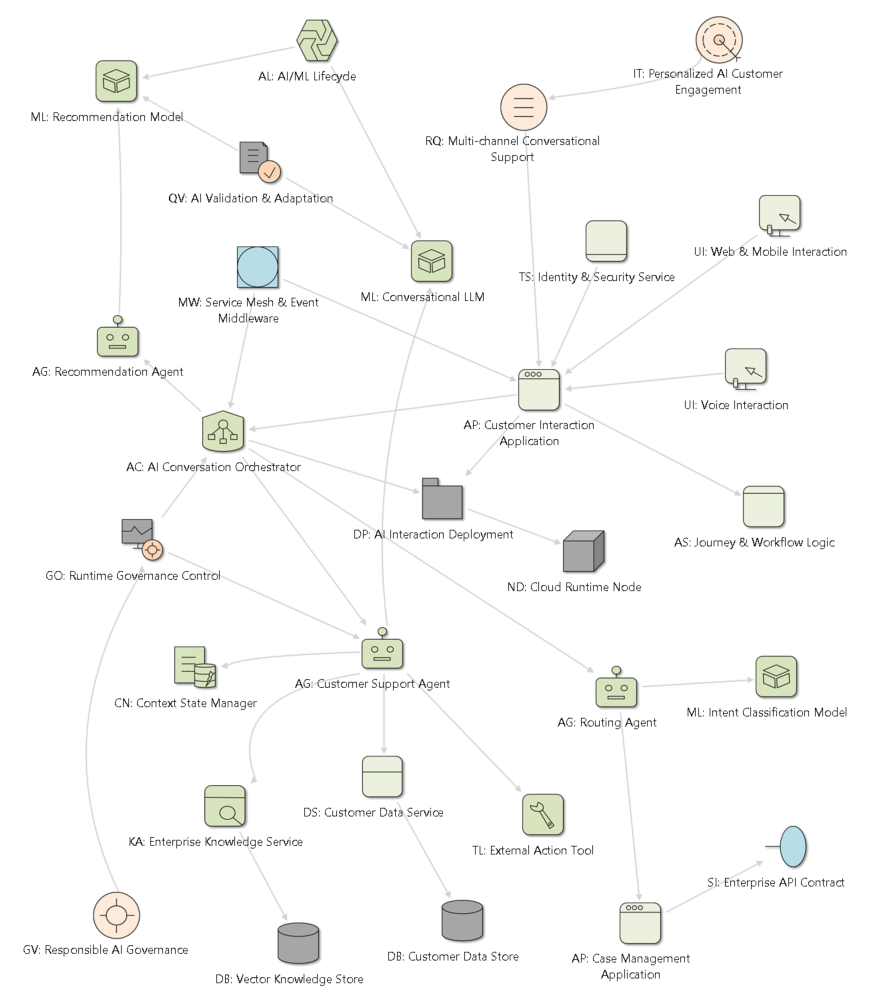
Figure 2: ASA Pattern Example
An Anti-Pattern Example
Figure 3 shows an “Isolated Agent Chaos” anti-pattern. This pattern shows that AI-native systems are not merely collections of agents. They require orchestration context continuity, governance, and operational control.
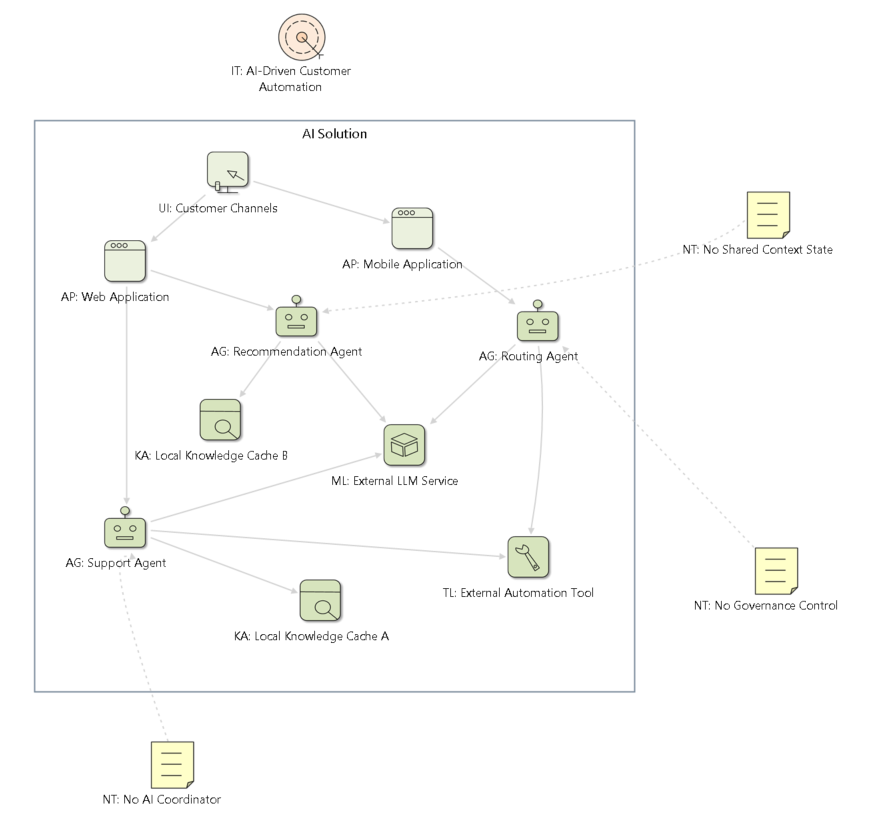
Figure 3: An Anti-Pattern Example
ASA Canonical Example
Figure 4 shows a canonical example of ASA architectural pattern for an AI-Native Enterprise Assistance Platform.
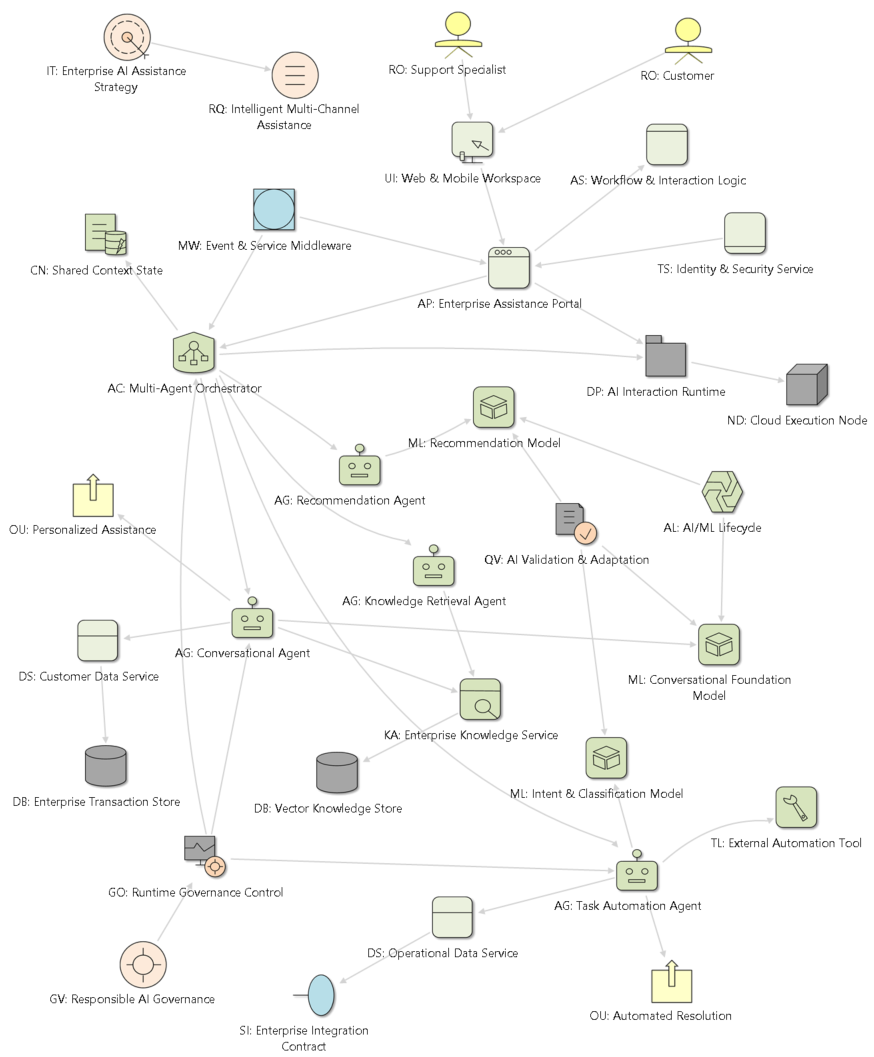
Figure 4: ASA Canonical Pattern Example
Unlike general reusable patterns, the canonical pattern focuses on holistic architectural composition and illustrates how multiple patterns can coexist coherently within a unified architectural structure.
Architectural Concerns
ASA architecture helps clarify architectural solution concerns in the following areas:
-
agent coordination, and adaptive workflows,
-
context management, and operational memory,
-
hallucination containment, and trust boundaries,
-
governance observability, and human override,
-
semantic consistency, and AI lifecycle sustainability
Human-AI Responsibility Boundary
Based on common understanding, the human–AI responsibility boundary can be listed as follows:
-
delegation boundary,
-
decision authority,
-
architectural override,
-
accountability mapping,
-
confidence threshold handling,
-
escalation patterns.
Roadmap to ASA Architecture
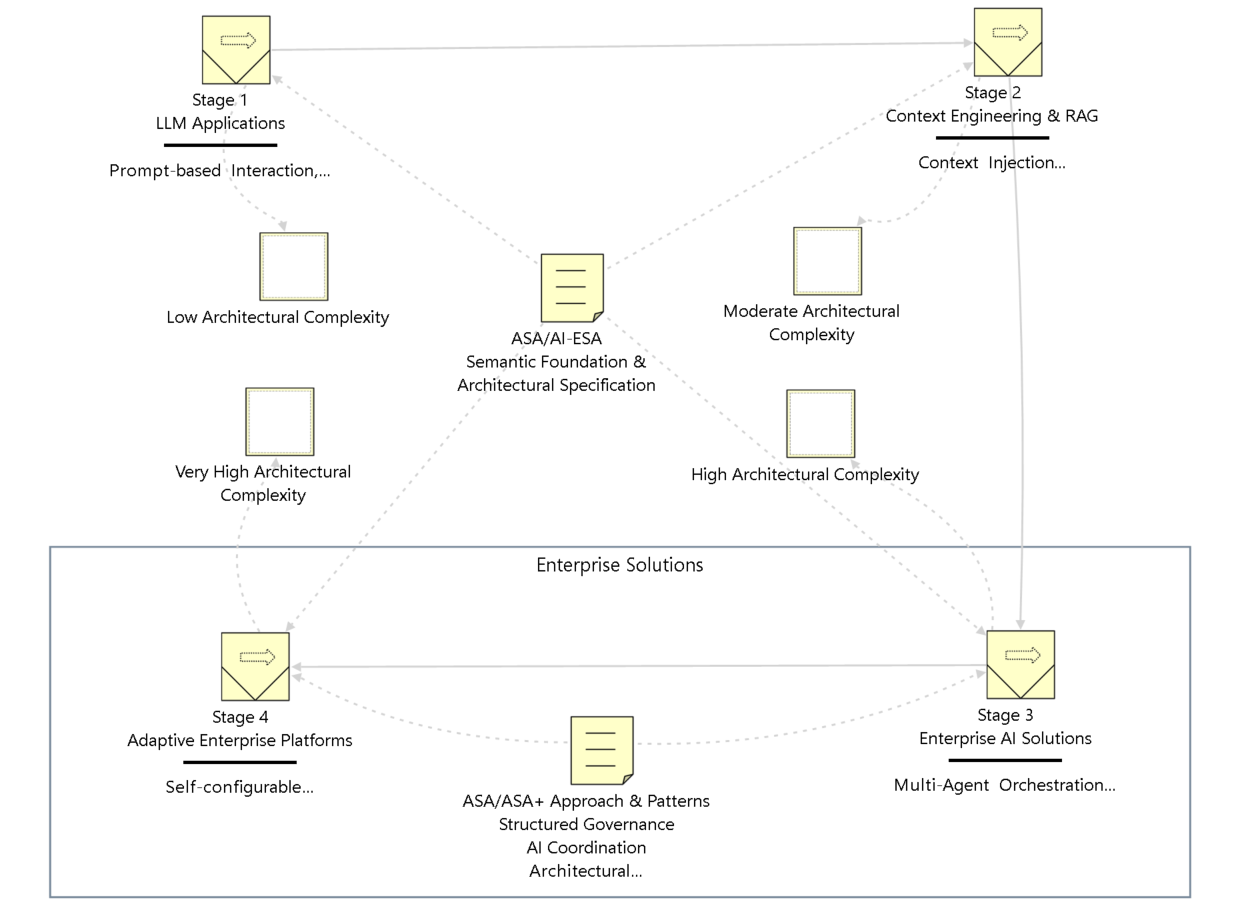
Figure 5: Roamap to ASA Architecture
As shown in Figure 5, AI solutions typically begin with LLM applications, then evolve into context engineering and RAG-based systems. This is followed by enterprise solutions, including enterprise-grade multi-agent orchestration, business-context-aware harness engineering, and future self-configurable enterprise platforms. ASA is most applicable in this enterprise stage, where architectural complexity increases and requires structured governance, coordination, and abstraction.
Each of the stage focuses on:
-
Stage 1: Prompt-based Interaction, Standalone AI Usage, and Basic AI Assistance
-
Stage 2: Context Injection, Semantic Retrieval, Knowledge Grounding, and Memory & State
-
Stage 3: Multi-Agent Orchestration, Business Context Harnessing, Workflow Coordination, and Enterprise Integration
-
Stage 4: Self-configurable Systems, Autonomous Optimization, Dynamic Governance, and Continuous Architectural Adaptation
Related Model Spec and Architecture
ASA uses its model specification and maintains a close relationship with ASA+ (AI-Augmented Solution Architecture).
For the relationship and relevance among ASA model and approach, and ASA+ approach, see this link.